By Michael Kline
My life is nearly perfect. I do what I want,
when I want, with whom I want. I enjoy good health, positive people,
good food, good wine and a nice home. I work when I want and enjoy more
creature comforts than I ever thought I deserved. In fact, my biggest
worry in life is that I don’t mess it up after coming so far. This is
the story I was telling myself. You must admit, it is a pretty good
story for a college drop-out, born to a drunk in a junkyard.
Cancer
took our mother when I was 7. As the 11th of 12 children, 4 of us were
adopted by an Aunt and Uncle who, in their better than their own past,
middle-class way, tried their best to fix us. They never let me forget
their disappointing discovering that in spite of their well-educated
efforts, you can “take the boy out of the junkyard, but you can’t take
the junkyard out of the boy”. Big Lie #1 - You’re no good.
“You
have to have a 4 year degree to be worth anything” Big Lie #2 –
Credentials define you, and you are not enough without credentials.
“Your
sister is going to become a nurse. (She did). She will take care of us
when we are old. (She didn’t). Girls become teachers, secretaries or
nurses. Since you are a boy, you need to grow up to be a lawyer or
something (I didn’t) because you have to support a family one day”. (I
didn’t do that either). Big Lie #3 – You cannot just do what you want.
I
could argue that I got my perfect life because I believed these lies. I
set small goals that I could achieve and achieved every one of them. I
dropped out of college, bucked the system, fired the boss and went out
on my own. I believed I was not good enough to subject myself to the
judgment of others; a problem I solved by becoming my own boss. I
believed that I would never make it as a professional, so I decided to
create a little success doing anything that was easy to learn without an
authority figure to judge me. Without a boss or teacher, my partner and
I went into flipping houses, then the food business and then retail,
each creating a little success. Life was perfect and easy, until one day
someone asked me if I had a purpose.
Purpose? I have to make a
living, that’s all I was ever taught. Purpose is a grandiose concept for
spiritual leaders, philosophers and politicians. My purpose is to raise
a family, make a living, pay off the mortgage and die. Looking at it
that way, I was not following the plan at all. As a gay man, I chose not
to raise a family, which admittedly, renders making a living much
easier. We already owned three homes with no mortgages, and at fifty
years old, in good health and bored, having a purpose for the second
half of my life intrigued me. Maybe my life was not really perfect.
It
turns out my core strengths are my capacity to love, my optimism and my
creativity. The work I do when I am most lost in time, in “the flow” as
they say, is teaching in a way that truly opens eyes and inspires my
students. The concept of a more ideal world that excites me is that
anyone and everyone should have the chance to flourish. The junkyard
that could not be taken out of this boy turned out to be a blessing.
Three lessons from the junkyard: Resourcefulness is more important than
resources. We all have the ability to create something out of nothing.
What we choose to be, do and have is entirely our own responsibility.
Cross off lie #1. You are good.
None of my skills are taught in
college, while a degree in chemical engineering, for which I had a full
scholarship, would not build my credibility in transformational work. My
intuition and wisdom at an early age however, to abandon such a
wasteful pursuit, is a reflection of my natural skills to discern what
is helpful and what is not. Cross off Lie #2. You define you, not
credentials.
Music was my passion as a teenager; specifically
the French Horn. I was good. Very good, if I do say so myself. And I do.
As I lost myself in my room, practicing hours at a time, I would close
my eyes and be playing first chair in the Cleveland Orchestra at
Severance Hall. On parental advice, I abandoned music to join the Air
Force Junior ROTC in high school, which would almost guarantee me a
scholarship, as would be required to pay for all-important college
education. I have since collected a lifetime of evidence that every
appealing venture I chose was successful and every unappealing thing I
was pushed into was a failure. Cross of Lie #3. You can do and you
deserve to do anything you like.
Today, my life is no longer
perfect. Today I have a purpose and I pursue my passions. I am
extra-blessed because my purpose and passion helps other people pursue
theirs. All my successes, even created on my own terms, were still
defined by the expectations of others. I was successful, as long as all I
had to do was make a living. To live a life engaged, on purpose, with
meaning and joy is perfect – perfectly messy, unpredictable, scary
seemingly irresponsible to some parental models. Perfect indeed.

Be Your Own Boss Part 2
By Michael Kline
In our last article, we talked about the great American Dream – Whether that is to create your own empire, open a neighborhood shop, or build a consultancy from a spare bedroom, most of us have had some desire to be our own boss. We discussed the popular reasons for starting out on your own such are creating income, personal freedom, self-expression, autonomy and creating wealth.
If you missed part in, you can catch up at www.intus.life/articles. If you read the last article, you should have decided by now if your goal is to own a business or to own a job – you understand the difference between being self-employed, and working for your own company. You understand something about creating equity in the business. You understand how that might influence your growth and exit strategies. Having an intellectual understanding of your business purpose, however, does not mean that it makes sense to you in your gut or your heart. It may be time to listen to your gut and/or your heart, so how do you have a conversation with your gut and heart without getting yourself locked up? I thought you would never ask!
Emotions first occur in our body. It makes sense that when you think of something that really bothers you, you feel it in your stomach first – maybe it’s public speaking, or heights, or conflict with a boss who scheduled you for an unexpected meeting, or spiders. Whatever it is, most of us have something that we feel in our body, an instant before our mind has a chance to give it any meaning. Feelings are the meaning we attach to the emotions that hit our bodies. This suffering is optional. We choose to give these meaning, based on our paradigm – which I define as our point of view with baggage. We all have our own perception of how things are and how things “should” be. We each have a long personal history with a lot of evidence that supports our position that public speaking is deadly – worse than spiders, which are scary, but not as bad as bosses. I tell you all this, because now that you recognize that emotions occur in the body, I invite you to listen to your gut – it is not just a figure of speech, but a common sense, practical thing to do, given that your gut knows the truth about what you should do with major decisions in your life. Sometimes our heart and mind is at odds with our gut, but most of us when talking about business decisions, let our heads do most of the thinking and ignore the heart and gut. It is time to call a whole-body meeting.
I have been lucky enough to assist on Jack Canfield’s team at his International success retreats. This month we had over 300 students, representing 32 counties and every imaginable profession, economic, political and religious persuasion. One of my jobs is to host private sessions with participants who get blocked with emotional or physical issues. It was a very busy and productive week for all involved. Working one on one with successful people from all walks of life, we discovered and rediscovered the power of finding resources such as strength, wisdom and answers from within ourselves. With the right methods, including some Canfield methodology as well as techniques I learned from the RIM Institute, we can strip away years of frustration, financial blocks, strongly held beliefs and assumptions to heal emotional and physical pain and reveal clarity and freedom to move forward on life’s most important goals. Even people with years of therapy under their belt, often find new paths to releasing ideas they thought were a permanent part of their identity. In truth, it does not matter whether we are talking about money, business, personal relationships or health, the blocks and beliefs that keep us back in one, often limits us in many areas of our life.
Like most decisions, business decisions should involve the mind along with the heart and gut. To learn more about how we actually facilitate a literal conversation with the mind, heart and gut, visit www.intus.life/rim.
Michael Kline is a Certified RIM Facilitator and Canfield Success Trainer for personal and group transformation. You can reach him through his website www.intus.life, or e-mail, mike@intus.life.
Be Your Own Boss

Would
You? Could You? Should You?
By Michael Kline
as published in Conway Daily Sun
The great American Dream – Whether that is to create your
own empire, open a neighborhood shop, or build a consultancy from a spare
bedroom, most of us have had some desire to be our own boss. I have interviewed hundreds of entrepreneurs
and want-repreneurs about the topic.
Reasons for starting out on your own are as varied as the business ideas
available. Top reasons include creating income, personal freedom,
self-expression, autonomy and creating wealth.
I listed creating income and wealth as two separate
categories. A livable wage/income can be created with relative ease, without
necessarily creating a business entity that has equity or wealth attached to
it. The simple question is do you want to own a job or own a business? Most startups come to me with an idea that
would allow then to make a living. They wanted to earn at least as much as they
currently earned at their job, but to be their own boss. If your business does not earn more than the
owner is paid to run it, you own a job. If you could hire a manager to run the
business and still pay yourself to oversee it and not be part of the
productivity, then you have business value beyond owning a job. Too many people
get excited about building a business they can sell one day for a multiple of
3-5 times what it earns. This is never the case when it only earns enough to
pay the owner. Before you start, decide
on your vision for the long term. There is not a right or wrong answer, but
your answer will direct your strategy and decisions about nearly everything
during the start-up phase. For instance,
borrowing money against your house to create a job never works. If there is not
enough profit beyond your salary, there is not enough cash to pay both the
owner and the mortgage. Even if you have the cash, this may not a good
investment, but there may be an emotional and psychological value worth every
penny. If your job is making you sick, the money very quickly becomes
secondary. You will want to spend some time discussing with a qualified advisor,
not just of the financial analysis, but the emotional and physical well-being
aspect of such big decisions.Self-expression and autonomy are listed separately because some types of work (and workers) are very creative in nature, while others simply have the personality that does not appreciate a boss. Experience has shown that many entrepreneurs, who start a business simply to rid themselves of a boss, fail at being their own boss. The reality is that these folks are not entrepreneurs at all, but rather workers who want to rid themselves of their boss and go back to doing their work. If you do the work anyway, then you could do better to go out on your own. The problem is that just because you understand the work, does not mean you understand the business. Whether it is being a hairdresser, retailer, chef or software engineer, your own expertise is not likely to include site selection, lease negotiations, employment law, supplier negotiations, sales, marketing, bookkeeping, etc. Every hour that you spend doing your craft, working in your business, is an hour that you are not working on your business. Outsourcing can help in the skill areas you lack, but is not as easy as it sounds. It is relatively easy to outsource bookkeeping, for instance. It is very difficult to outsource sales and client negotiations in a service industry. It is equally difficult to outsource supplier negotiations and new growth strategies in any industry.
To be successful, the would-be entrepreneur would benefit
from some deep soul-searching. Do you have all the skill sets required for your
business? Is it reasonable to outsource the areas where you lack expertise? Do
you have the money? Can you and should you borrow the money? Are you truly
passionate enough about the work to see you through the (all-too-plentiful)
tough times? I know you may not like having to explain yourself, but you should
be able to explain your specific goal and why you want to own a business, at
least to yourself and your family.
Like most decisions, this one will be emotional and that is
okay. We tend to use our intellect only to rationalize our emotional decisions.
I have lost count of the number of friends and clients who should not have
started a business, but acted on the emotional drive to do so. Their stories
generally do not end happily ever after. Most of us crave autonomy, mastery,
achievement and financial freedom. This requires taking 100% responsibility for
our lives, which may or may not require starting our own business. If you truly
are an entrepreneurial thinker, you may be able to do well enough working for
others that you do not need to take the risk and endless tasks of business
ownership. My partners and I will be leading a 3 hour workshop on this subject,
Thursday evening July 30 at the Met Coffeehouse in N. Conway. Cost is $20
including food and drink, visit our website to reserve a seat.Preparing a work-ready youth

As I conduct training programs for local employees, I find a few common threads. I discuss many of them in this column and often I take aim at employers, because that is most of my audience, and I urge them/you to take full responsibility for creating an environment and culture for success. That said, I see in the classroom, as well as in the local businesses where I shop, that we have a shortage of well-qualified, well-trained ready to work employees.
In spite of state, local and school district efforts, the challenge of finding work-ready employees seems to be on the minds of employers I meet. I am told that coming out of high school, many teens seem to lack any work ethic. I disagree; I think they lack a sense of responsibility, goals and training. The results are the same, so let us stop blaming and consider what we can do about it. If you own or manage a business in the valley, your livelihood may depend on finding or cultivating your own better workforce.
Imagine a workforce in which employees are clear about their goals and are self-motivated to reach them. The goals are broken down into manageable "how much, by when" segments that allow them to get their jobs done with ease because the big picture is clear and concise.
Even if they do not want to have a lifelong career in hospitality, retail or customer service, they should see the value in learning new skills, expanding their knowledge, and saving money to support the pursuit of their personal vision for the future.
Imagine improved customer service because employees are motivated to create a better experience for both themselves and the customer because they understand that the way they respond to events directly impact positive outcomes or a workplace where interpersonal relationships between coworkers improve because they connect with each other authentically and appreciate all each of them brings to the team.
As my regular readers know, I have been involved in Jack Canfield training for a while now. My friend Trish Jacobson introduced me to Jack’s programs. While I have been incorporating many of these principles into my work with individuals and business clients, Trish has been busy working with our youth. This past winter, she applied the Jack Canfield’s Success Principles to a local ski school. By approaching each day with a sense of passion, purpose and clear vision of the outcomes she wanted to create, she was able to develop a cohesive team of dedicated people who took pride in their involvement in the bigger picture. Their sense of personal responsibility, willingness to learn, and their communication skills all greatly improved throughout the season. The staff bonded through their shared mission of impeccable customer service, which showed up in resort surveys directly measuring aspects of customer service and satisfaction. I should mention that about half of her seasonal staff was under the age of 25.
When she is not on a mountain, Trish works with young people through the White Mountain Community Health Center Teen Clinic and Community Outreach programs. She and her team make a significant contribution to Carroll County having one of the lowest teen pregnancy rates in the entire US. In 2010 she began incorporating some of the same principles into her health curriculum. In 2014, she founded the Pathways to Success for Youth Project. Her vision is to develop a classroom and online curriculum, which includes solid principles of success, elements of passion and purpose, tools to build self-confidence. At the same time, the program will help clear self-limiting behaviors and beliefs and instill a foundation of personal responsibility, goal orientation, taking action and entrepreneurial skills.
Clearly, the Pathways to Success for Youth is onto something - something big. This has the potential to transform education, our workforce, and create endless positive ripple effects. Trish, youth leadership colleague Mikayla Cerney and I will all be on Jack Canfield’s assisting team in Scottsdale AZ in August for a weeklong Breakthrough to Success training program. This program retails for $3500 per person, and Canfield global community has donated eight student scholarships as well as lodging to Trish’s program. I hope as the local community whose youth directly benefit, we can raise the airfare and other costs to invest in eight of our local high school students to experience this truly transformational program first hand. How different my own life would have been if I knew as a teenager, what I learned in this program at in middle age. For more information about helping our youth prepare for a more responsible adulthood, visit www.pathwaystosuccessforyouth.com.
What lies beyond success
 By Michael Kline
as published in Conway Daily Sun
Don’t you just
love it when someone recommends a book you don’t want to read? I did not need a
book called The Success Principles. What could one more book teach me that I
hadn't read a thousand times already?! This was the dismissive thought running
through my mind as a friend was espousing the wisdom of Jack Canfield. I have already been outside of my comfort
zone, I was already thinking outside the box, I was already living the dream. I
reviewed the official checklist of success items in our culture. My partner and I had already started a
business. We had done that 6 times already. We have the house we want, the
fancy car, the black lab and a winter home in Florida. I had traveled, tried
new things, risked failure, risked success, learned to de-stress, lost weight,
embraced nature and enjoy many positive relationships. Leave me alone, my life
is perfect!
I had heard it
all before. Responsibility, goals,
accountability, blah blah blah. To be honest, I went well beyond blah blah
blah, I threw in a yada, yada, yada, which is a considerably more refined
denunciation of the particulars being discussed.
You don't know
what you don’t know... I should have bought the book. I could have had a quick
read and put it on the shelf with a thousand other books, each with its promise
to be the one that would change my life. That would have been too easy.
Instead, I signed up for a year-long train the trainer program with Jack
Canfield, author of The Success Principles. I thought did not need the
principles, but I did want to expand my training business and learn from the
master.
I did not know
how to admit I was stuck. I did not know how to set a goal that was (up until
then) unrealistic. I did not know how to quiet the critical voices in my head.
I did not know that everything I knew for sure was subject to change. If I had
read the book, it would have confirmed that I already knew it all and nothing
would have changed. The experiential version of the same principles landed me
on another planet where there is no gravity, energy is visible and emotions
ooze out of your pores.
How Jack Canfield
ruined my life… My life was perfect, until I knew it wasn't. I went into Jack's
classroom, ready to become a world-class trainer and grow my seminar business
accordingly. Day one - I am in over my head - this room is full of successful
entrepreneurs, authors, speakers and gurus of all types, from all over the
world. I have done nothing compared to most of these people. What's that? I
shouldn't compare myself? I know, but have you seen these people?! What's that?
You want me to state my life purpose? Out loud? What's next, you want me to
admit my father didn't love me and my mother didn't breast feed me and my
biggest fear is that people will find out that I don't really know what I'm
doing? Oh. Okay, I admit it. I have baggage. Lots of baggage packed with fears,
beliefs I know to be absolute truth, and a couple of jackets called confidence,
that I sometimes wear to cover up everything else. Yes, I also packed a
swimsuit, just in case I decided to dive in, and running shoes in case I
decided to make a break for it. Yes, I'm still speaking in metaphors while
wondering if I had adequate writing skills, should it feel necessary to point them
out. My ego was a melted puddle on the floor and my self-esteem was rocking in
a fetal position in the corner. What a mess Jack Canfield made of my life!
I was happy,
healthy, financially secure, capable and confident. Now, my life is about becoming
more authentic, vulnerable, loving, open, and pursuing frightening things. I am
risking exposure, failure, success, my identity, my self-concept and my future
on something as trite as finding my life purpose and living it completely. I was raised by a man who would say there is no
reason to complicate your life with this nonsense. When you have nothing to
complain about, just keep your head down and stay out of trouble until you
qualify for Social Security and sail off to your funeral. What drives us to
yearn for more than simple “Success”, whatever that is? When you have the life
everyone else wants, you should be grateful. What if, beyond being grateful, it still
doesn’t feel like enough? What is enough? What could be different to make it
better instead of just more? How do we get beyond success, to find real meaning
and fulfillment in our lives? Is it simply a matter of redefining the word
success to include more meaningful concepts? Why are these concepts so universally
sought and yet so universally elusive? This is my new quest. To live my life
purpose and help others find and live theirs. It will be hard. It will be
scary. I am doing it anyway.
Too Personal for the Workplace

What is it you want to improve at work? Customer service? Patient care? Quality
control? Error rates? Sales? Communications? Employee Engagement? Check out
this bit from Inc. Magazine: “Forty-seven
percent of employees say that problems in their personal lives sometimes affect
their work performance, according to new research by Bensinger, DuPont &
Associates. The firm asked 24,000 employees using its employee assistance
program how personal issues were affecting their work. More than 16 percent
reported that their personal challenges caused absenteeism, and nearly half
said it was hard for them to concentrate. Take note: If you think problems in
your team's personal lives have nothing to do with you, you're wrong”.
At the far side of every training program there is a goal
for work-related improvement. You already possess the technical skills to run
the day to day operational aspects of your workplace, so what skills are needed
to make the improvements we are talking about?
They are personal by definition. They involve the person and the
personality and the unpredictable nature of the person, doing the work. If we
do not make the training personal, the complaint would be that we are trying to
script/program everyone into robots. At the same time, many people have the
notion that personal matters are off-limits in the workplace. It as if there
was some sort of law that personal matters are never to be discussed, with
every individual deciding where to draw their own line defining what is
personal.
Somewhere in the middle of every training program, there is
a collage of personal issues that drive the problems and the solutions to our
problems. My job is to inspire, motivate and train people in patterns and
practices that bring about success, however they define it. If your people have
low self-esteem, low self- confidence, their goals are too small, they carry a
scarcity mindset, they fear rejection, fear failure, fear success, or do not have
a clear vision, are these people going to help build success in your
organization? If you have these
qualities, are you going to enjoy success in your career or your life? Imagine
having a high level of confidence and the strength to ask for help when needed.
Imagine having such an abundance mentality, that credit could be shared, and
responsibility could be taken without a need to assign blame for mistakes.
Imagine the productivity levels if everyone, including yourself had goals that
made sense and correlated with a personal passion to drive results. This is
personal. This is uncomfortable.
Indeed, if I do my job correctly, many participants will
feel uncomfortable. All the good stuff happens just outside your comfort zone,
is a popular phrase on Facebook memes, but that doesn’t make it any easier to
be uncomfortable. I often start a workshop with the invitation to get
comfortable, being uncomfortable. We can easily get used to being comfortable
with a little discomfort and start to experience the richness of personal
growth. Mind you, we do not do really deep, super-personal work with groups in
a work setting; and we are talking about creating just a little discomfort,
balanced with an atmosphere of emotional safety.
If employees (or employers for that matter), feel unsafe
sharing what they consider to be personal matters at work, it could be a
reflection of their insecurities or a reflection of the culture in the
workplace. If trust with co-workers or the boss is low, we would need to work
on that first. This summer, we have been running short public workshops dealing
with some very popular topics that dramatically affect how people perform at
work. These short workshops are very small groups of people who generally do
not know one-another and don’t work together. Somehow, this makes it
emotionally safer to get voluntarily more personal. It is almost universally
true that people are more comfortable sharing personal insights and challenges
with total strangers than they are with coworkers. What does that say about our
work relationships? What level of trust is there at work if strangers are safer
than co-workers? Strangers are not gunning for your job. Strangers will not
fire you, gossip about you, or punish you with lousy schedules as a result of
knowing your secret weakness. It is easier to hold in the stress and make
ourselves literally, physical ill than it is to risk being vulnerable at work.
It pains me to know this. It pains me to know so many workers (and bosses) who
are actually living this way. It is unnecessary. It is personal. It is also a
work issue. The workplace is making us sick with toxic environments that do not
support the emotional needs of the workers. It is my observation that not only
do most workplaces not proactively support these needs, many are actively
contributing to the problem. We teach what you allow. Shouting at employees,
verbally abusing one another, storming around like angry, drunken, violent
parents with no coping skills, is acceptable behavior in too many workplaces.
On the other end of the spectrum, some employees (and some employers) simply
shut down at the first sign of conflict. They may even feel that any question
of their work, no matter how kindly presented, is a personal attack. These
people simply shut down and walk away from conversations as if their passivity
would protect them from the impending storm that does not even exist outside
their imagination. We wonder why we must “walk on eggshells” with some people,
who are not strong enough to handle any feedback or input at all. How are these
situations going to get better without being personal?
We need to be willing to get to know ourselves and care for
ourselves first. We then need to know and care for one another. We connect with
others through stories, awareness and empathy. We build trust by extending
trust, by making and keeping promises, and by being transparent. These things
require personal strength and self-confidence. It is time to get uncomfortable
and stop hiding behind our “right” to not deal with personal matters. It is
time to live healthy, happy, vibrant lives and surround ourselves with other
happy, healthy vibrant people.
Employee Engagement - What it is and how to get it

Last week, I had
the pleasure of conducting a workshop for a group of human resource executives
from around New Hampshire. To be as participatory as possible, we used Circle
Process to facilitate the program, and opened with a check-in question to
identify the meaning of "engagement" in the various organizations
represented. We built a center focal point of the words shared by the
participants. Mostly the words and accompanying explanations were traditional,
such as participation, teamwork, compassion, communication, drive, active, respect,
etc. All of these certainly are indicative of engagement. Further discussion
went to explore ways to measure employee engagement, possible ways to increase
it and challenges to expect in the process.
We discussed Gallup’s
defining surveys on employee engagement. Gallup surveys over 6400 employees
representing a wide demographic, scoring employee engagement nationwide. Painting
with broad brushstrokes, less than 30% of employees are engaged, about 50% are
neutral and almost 20% are actually hostile. How do we measure engagement? The
survey asks participants to rate a variety of issues ranging from having a best
friend at work, to having the tools necessary to do a good job, to getting feedback
on their work. The results of the Gallup research are closely tied to a
company's financial bottom line, as well as customer satisfaction, work quality
and safety issues.
Problems occur
when management focuses excessively on measurable short-term results. They do
not have time for emotional issues; they simply need employees to show up and
produce results. These management types often define engagement as showing up
and putting in long hours. Knowing that engagement is a trendy topic, they
often plaster the trendy “engagement” word on the same old programs and pretend
it is something new. This is not the same as truly embracing the complexities
of whole-person leadership in the knowledge-worker age. Unless you are running
an assembly line with illegal immigrants, the industrial age is over. It is time to move beyond these old management
models. Un-engaged management often
calls real engagement work "touchy-feely stuff” and they relegate it to
the HR department to process it for lower level employees, so long as it
doesn't cut into productivity time or budget.
The solution is
for management to become a leadership team and understand that engagement is
the shortest path to sustainable results. Engagement is measurable and is
directly tied to all areas of results for employees, customers, stockholders,
vendors, etc. Engagement requires vulnerability, which requires enormous
strength and courage. Engagement requires giving employees a voice, but not
necessarily a vote. It requires making everyone feel safe, cared-for, heard and
respected, even when they do not get their way. In such an environment, it is
possible to build consensus and support even while disagreeing. The time-consuming
hard work required to invest in engagement produces a culture of high trust,
low cost, fast moving, mission-focused, and committed workers doing what they
do best, in the best possible way.
The vast majority of the
good work employees do is discretionary. They do not actually have to do their
best work to keep their job – just compare your top producers with your least
productive who still keep their jobs. Cleary, the top producers go above and
beyond what is technically required of them. Your goal is to get them to do
that more often and to enjoy doing it. The joy they find in giving more is the
only reward they need. This only happens if the employer is deserving and when
the employee is emotionally connected to the work, the mission and the values
of their employer.
Because I wanted
to model high-engagement practices, our HR workshop allowed for a high level of
audience participation. One participant asked a question that was supported by
the group and shifted the focus from what I expected I would be teaching.
Teaching what the group wants to learn is far more engaging than teaching what
I want to teach. The lesson is that identifying ideas that employees find
important, and taking advantage of the energy that lies within those ideas, is
how employers can engage the discretionary contribution of employees.
We have 8,800
non-profit organizations in NH. With most employees not engaged at work, huge
numbers of employees choose to donate their personal time to non-profit and
charity work. This is further evidence that many employees have much more to
give than their work requires or even allows them to contribute. People have
more to give, but not at work, because work is more emotionally exhausting than
it is rewarding. People would rather do work that is technically even harder to
do, but that is more emotionally satisfying. This represents the untapped
potential of the team you already have on payroll. They are starving for an
employer that will allow them to reach their potential, to contribute to
something worthwhile, to grow in mastery, autonomy and with purpose. Your
opportunity is to unleash that potential for them.
Michael Kline is a
Certified RIM Facilitator and trainer for personal and group transformation.
You can reach him through his website www.intus.life, or e-mail
mike@intus.life.
From Orphan to Soul Man
 By Michael Kline
as published in Conway Daily Sun
I spend several weeks each year, attending retreats and
seminars to hone my training and coaching skills. Of course, each of these
adventures involves as much personal growth work as it does skills training. Personal
growth work is not difficult or painful, except when it is. My regular readers
know that I am always willing to share my vulnerable and uncomfortable growth
lessons with you. This is one of those articles. I am writing this article from
Denver, where I just finished my final week of Certification Training at The
RIM Institute. Regenerating Images in Memory (RIM) is a powerful Integrative
Wellness Technique useful for myriad issues personal and professional. As a RIM
facilitator, it is important for me too consistently do self-work, which is the
subject of this story.
This story is for the benefit of anyone who has ever been,
or would likely be, embarrassed at a workshop by participating, speaking or
performing in front of the entire class. Picture being asked to share a
personal story, or to lead the class in a dance exercise as an energy break.
The worst one I have ever done until this week, was to get into a group, and
lead them in a dance. Disco. The group was to follow my lead and mimic my every
move. Just shoot me. I survived that exercise when I did it a year ago, but I
disliked it enough to not want to inflict it on my own classes, so fear not,
regular students!
Last week, my classmates and I received an assignment so
bizarre, I was certain it was a trick assignment. Perhaps the goal was to get
us to stand up to authority and refuse to perform such a ridiculous task that
could not possibly serve any purpose other than to humiliate us. I have a great
deal of trust in our instructor whom I have known and worked closely with for
over a year, so I decided to play full out. Then I thought I might make a run
for it instead. I could head to the airport and abandon my certification. No,
no, I can do this. No way, I can do this. This cannot be done. Oh grow up and
get to work, I finally told myself. It was 2pm and we had 4 hours until we were
to be on stage presenting our work to classmates and invited guests. How far
was the airport again?! Was I being too
much of a chicken? It is not like I was asked to play Chicken Little being
transformed into Wonder Woman singing This Little Light of Mine. Or worse, I
could have been asked to model Professor Higgins from My Fair Lady being
transformed into Dr. Seuss singing a Barbara Streisand song. Now that would have
been ridiculous and humiliating, am I right?!
These were real assignments, beautifully delivered by two of my
classmates. I had it easy; my only task was to portray Harry Potter as the
pre-wizard orphan living under his aunt and uncle’s staircase. I was to
transform into John Belushi singing Soul Man. Yes, I was given the lyrics and
the music, being expected to sing and dance. I don’t sing. Ever. Not even Happy
Birthday. I rarely dance in front of sober people. Actually, I am certain I
have never danced in front of sober witnesses. Surely, there would be valuable
lessons in this exercise. To think I paid good money for this experience. I
combed my hair over my forehead and donned my sexy new Harry Potter glasses. I
waived my magic wand with a few spells that were completely ineffective at
making the audience or myself disappear. As Harry stopped being small, he
discovered powers from within. As Harry transformed himself, using the genius
he found within, he grew and found his soul; his voice. As wand and wire-rims
were replaced with hat and dark sunglasses… I’m a Soul Man.
Lessons learned: I can sing and dance like a soul man. I
will never get a recording contract, but I will do anything to become the
person who can best help my students and clients. I look ok in a hat. I look
freakishly like Harry Potter in wire rims and I can own that too. I am me, and
once I did what I once judged ridiculous, I found that the judge voices I have
carried in my head for 50 years were silent. They dared not speak. I think I
scared the crap out of the voices in my head. They probably left for their own
little judgmental airport for fear of being embarrassed, caught in their lies
and weakness. No little voices in our head can be as big as our true voice once
found and expressed into the world. You do not have to do this particular
exercise, but you do have to find your voice and your soul and share them, lest
you die under the weight of the weak and judgmental voices carrying lies.It’s all in your imagination
 By Michael Kline
as Published in Conway Daily Sun
When we imagine an amazing dinner, a walk
on the beach, a new romance, or just getting home to relax, the images in our
mind are very real to our brain and our body. These images can change our heart
rate, our breathing, our stress levels... the brain does not know the
difference between real and imagined. If you close your eyes and imagine you
are on a giant rollercoaster… slowly, slowly, rolling up toward the sky…
looking almost straight up… you feel yourself leveling off at the top…the track
disappears in front of you… your stomach senses the impending drop… you feel that?
Even as you sit safely on the ground, reading this article, you can create a
physical reaction in your body. Your brain sends the same signals raising your
blood pressure and stress levels, and releasing cortisol and adrenalin as if
the event were real. If you have ever blushed when embarrassed, or if your
stomach churns when you speak in public, you are already a believer in the
mind-body connection. It is so easy to demonstrate how our brain affects our
body whether the event in our brain is real or imagined. Somehow, when it is
suggested that our brain has a role in disease, illness and physical pain, we
tend to prefer a reliance on western medicine, pharmaceuticals and hard
science. As science advances to explain phenomena that only a few years ago were
considered too hokey for mainstream consideration, it begs bigger questions.
If the brain has such influence over the
physical body, imagine the influence it has over our emotions, fears, hopes,
inhibitions and even our most strongly held beliefs. Humans are born with only
two natural fears – the fear of falling and the fear of loud noises. Everything
else is a learned fear, based on some experience or outside influence. The
things we hold most dear in our belief system are all made up and placed into our
minds by our parents, teachers, preachers, TVs and experiences. Imagine if just
some of the things you were convinced to believe were false. What if you could earn a living doing what you love?
What if you could find the perfect
mate? What if being fat (or skinny/short/bald/poor/stupid) was not in your
genes? What if you were smart enough
to pursue what you want? What if guilt did not exist? What if money was not the root of all evil? What if
you were pretty enough? What if you were strong enough? What if the
neighbors’ opinions did not matter? What if thinking of yourself was not selfish? What if worrying and was
unnecessary? What if suffering was optional? What if you were not subject to
harsh judgment for every mistake you make? Would you be willing to consider
just the possibility of some of your beliefs being untrue?
This concept affects everything we do at
home and at work. If we believe we are always subject to harsh judgment for
mistakes, are we less likely to take risks at work or in business? Does being
successful at work require taking some measured risk? For many people, just
speaking an opinion or idea out loud, even when solicited by the boss, is too
intimidating due to the fear of being judged stupid, naïve or unqualified in
some way. It is easier to stay quiet than take the risk. A low-trust
environment may have influenced this, or more likely, it is the perception of
fear based on our imagination. Somewhere in our childhood, we made a decision
about how the world works. We all have vivid memories of mini-traumas; maybe it
was that time in the third grade when you raised your hand, made a silly
comment and everyone laughed at you. Maybe your parents sarcastically said you
would never be a brain surgeon. Whatever it was, maybe it is time to reconsider
your beliefs. After all, a belief is just at thought that we keep on thinking.
Once we think something, we start to find and store evidence to prove our
thoughts correct. Then we keep thinking it and it becomes a belief.
When I work with private clients, they have
amassed evidence to prove their beliefs. In a typical session we identify the
original thought that started the belief and uncover a mountain of evidence
that would prove alternative beliefs. Armed with new evidence to consider, it
is then possible to make new choices about how their world works for them.
Having witnessed this transformation too
many times to count, I know we can choose a new truth. We can show up at work
ready to serve and prosper, while helping others prosper. We can come home
every day, fulfilled and eager to enjoy our loved ones. We have the power to
use our brains to alter our physical state in an instant, which means we have
the power to use our brains to create whatever experience we want in our lives.
Sure, it takes a little training and sometimes a lot of clearing of old ways,
but consider the payoff. What if dreams really do come true? What if anything
really is possible?
Accountability, a threat or promise?
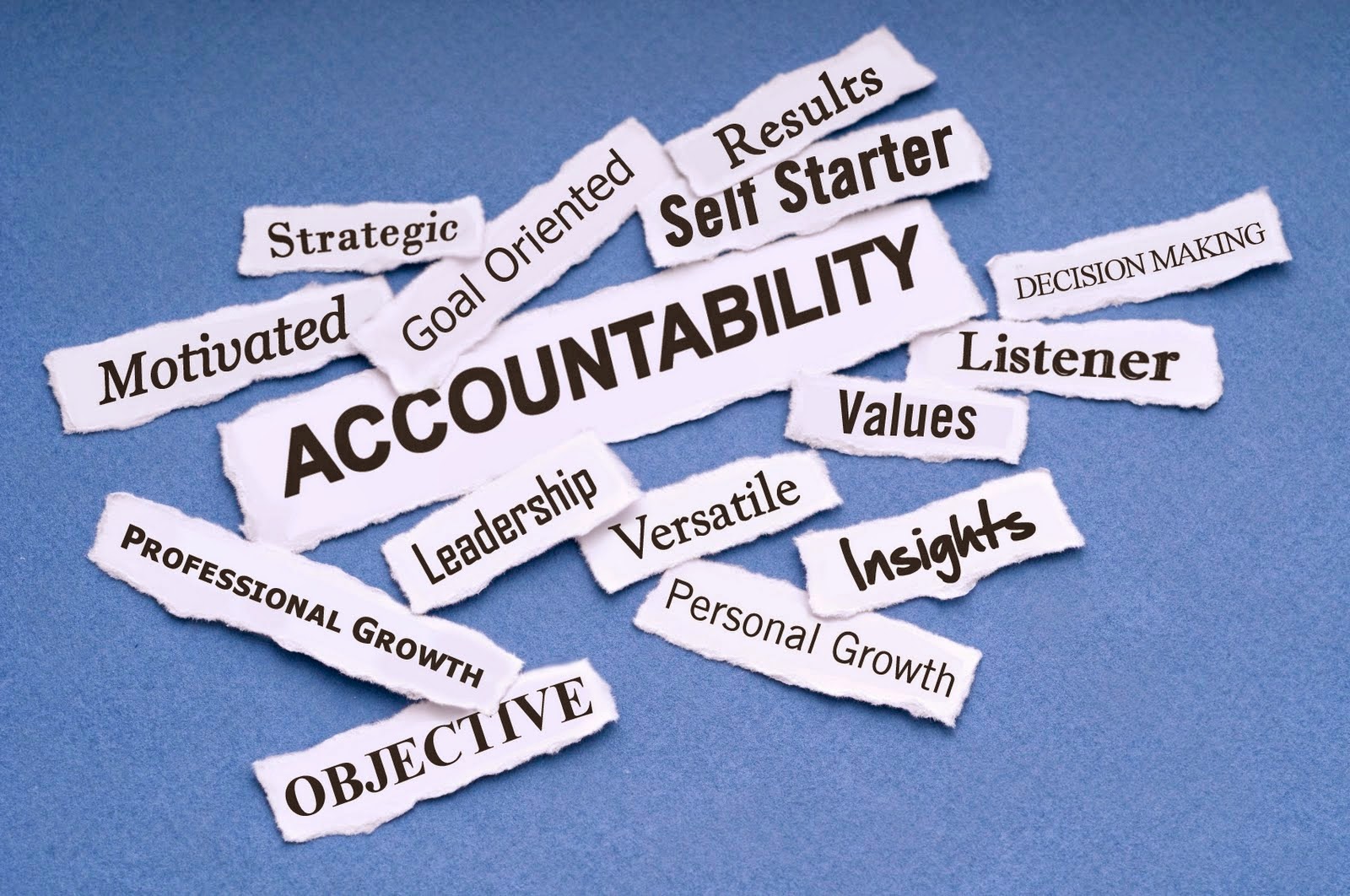
What does accountability mean anyway? When we first learned about accountability as a child, it was probably through one of three ways, religion, parenting or teams/society. Your lessons in accountability might have been threatening - as in when you die, you will be held accountable for your sins. You better not screw up, or your will pay for every mistake or bad decision you ever make. Further, you will pay the ultimate and highest price imaginable. Perhaps your parents had a system of carrots and sticks such as an allowance and privileges associated with the completion of chores and homework, and punishment associated with a failure to perform as expected. Beyond religion and parents, society teaches us what is expected and how we will be held accountable for achieving or not achieving what is expected. That society could have been made up of scenes on the playground, classrooms or sports teams. The closest I ever got to sports, was that time I was “sporting” a bad haircut. I learned that, as a child, if you have bad hair, your peers held you accountable for “less than expected” performance. Unfortunately, that playground standard is still the norm for many people, and we all have bad hair days.
I was a band geek, so on a more positive note (pun certainly intended), I learned about teamwork and accountability by only being able to achieve my goal by working with up to 200 other people in perfect harmony (pun certainly intended), to produce the desired outcome. There was an implied and voluntary promise to practice, learn our parts, listen to one another, play in the background when that was your job, and to step up and perform brightly in a solo when that was your job. Every mistake made in practice brought encouragement from the “team” who could not succeed without my success. Every mistake was letting my friends down and drove me to work harder for the goal.
This was different from any other experience in my young life because it was voluntary. I chose to be in band. When we do not care about the goal or the team, there are not enough carrots and sticks in the world to make us better.
Accountability works best when it is a voluntary, two-way promise, made between parties with a high level of trust, to produce win/win results that matter to everyone involved. When employees have no input in the plan, when they are told what to believe in and how to produce the results, when teammates are negative and uncaring, it is impossible to carrot and stick them into being accountable for your success. A culture of mediocrity will not produce more than mediocre results. Results will only change when the culture changes.
To be accountable is to be trustworthy. Like all virtues, this begins with our self. Without it, we will not be comfortable being held accountable and we will not honestly and effectively hold others accountable. If we break our promise to get up early, exercise, eat right, be patient with our kids and clean the garage, we no longer trust ourselves. We do not like or feel good about people we do not trust. If this resonates with you, do not beat yourself up. I teach a number of methods to turn this around easily and quickly. You are a good person who is doing good things. Most of us just need a tweak now and then to get back on the right track.
Involve your team, keep your promises and be strong enough to value feedback. Engage your team by actually wanting and valuing their input. Keep promises by making sure you keep promises to yourself. Solicit and value feedback – after all, if you are screwing up and no one says anything, it means they have given up on you. Only speak what you truly believe and do what you say. Most of us think we already follow this, but others might misunderstand our actions and not believe we walk the talk. In teams, others’ perceptions are critical if accountability is to be a promise, not a threat.
Appreciating Employees
By Michael Kline
as published in Conway Daily Sun
as published in Conway Daily Sun
Before you look for ideas on how to show your appreciation
to employees, it is easier if you actually feel some appreciation for them in
the first place. Where do you fall on the appreciation spectrum?
At opposing ends of the spectrum, one employer (who may
sound shocking to some) says “Employees are paid to do a job; they cost wages,
benefits and taxes, plus recruiting and training is expensive. Now they want a
bonus for doing what they were hired and paid to do in the first place. There
is no loyalty so they’ll leave the minute they get a better offer anyway. Most employees only do what is required of
them, and only care about their paycheck.”
At the other end of the spectrum, an employer (who may sound
shocking to some), says “I could not live without my staff. We would have
nothing if not for them. Most of the best ideas come from my people, my
customers love them and they come up with solutions to problems before I even
know we had a problem, they create new ideas to make our work more fun, and
they’re always inventing some new and better way of doing things. I owe my
career and financial results to my team!”
If you find yourself wishing you lived at the positive end
of that spectrum, but it seems unrealistic, you should know that such work
places do exist. In fact, they are more common than you might think. If you’ve
never seen such a workplace, it may seem impossible to achieve. I invite you to
expose yourself to more positivity – read books like Theory U (okay, that’s a
giant book that never ends, but I would give you credit if you just skimmed a
few chapters). Read Conscious Capitalism and/or Firms of Endearment. The companies featured in Firms of Endearment
are the highest super-achieving companies in the world, yet what they do and
how they do it is startlingly simple. The culture described above is in fact,
possible as soon as the leadership believes it is possible. Once their minimum
financial needs are met, most staff values appreciation more than money and
benefits.
To increase your appreciation of staff, start by
appreciating your staff. That’s right,
appreciate is a verb – it is something you do, so just do it. I have a few
gratitude buddies. Each morning, I text this small group a short statement of something
I am grateful for. There are 4 of us in
the group, so if I forget one morning, I will get a text or two from my buddies
to remind me. I admit, some days it can be difficult to feel grateful, even
though intellectually I can name 100 little things for which I could be
grateful, I may just not be feeling it. Bringing this to my attention is
powerful. I force myself to state something, anything. You could do this at work each morning and
make it about something or someone at work that you are grateful for that
day. You may be surprised at how
powerful this exercise is when you do it every day. If you’re at that point,
you could encourage your entire staff to participate in something similar.
If you are not normally one who expresses your appreciation,
you may be seen as insincere when you start making awkward and manipulative
sounding statements. Just smacking someone on the back and saying “good job”
might backfire and build resentment. I suggest you be honest and make yourself
a little vulnerable. Simply start by admitting that you have become aware that
you don’t express your appreciation well and you would like to get better at
that. Tell them up front that you are trying to get better and that you value
their contribution. If you are a step-by-step person, try building up to the
thank you in 3 simple steps – use their name, tell them what you appreciate
them for, how it helped, and then end by saying thank you. For example “Alice, I appreciate your help
with the newsletter. Thanks to you, we got two new customers this week who
responded to your idea you put in the newsletter and it already brought in X
dollars. Good job. Thank you!” Now,
would that be so hard? - Remember – use
their name, what they did, how it helped and thank you!
Anyone can do this, you don’t have to wait for your boss to
lead the way. In fact, the boss might get more comfortable after she sees you
modeling it! Anyone can follow this technique with any co-worker, boss,
supplier or customer. Think about it, on
days when you went home feeling under-appreciated, would it have helped if
anyone at all had shown some appreciation to you? Of course it would! So you can do the same for anyone you meet.
Try it on the cashier at the grocery store. Try it on your spouse or children.
As the saying goes, become the change you want to see in the world.
I appreciate you. I am grateful to my readers who email me
and share my columns via Facebook or email. This helps spread positivity and
productivity to others and when you send me messages it encourages me to write
more and lets me know my work has value. That makes it much easier for me to do
what I do every day. Thank you!
Engagement:The Missing Link

as published in Conway Daily Sun
You can’t get very far surveying the current wisdom of cutting edge management theory without coming across the issue of engagement. Organizations like Gallup and Towers Watson continue to do large scale research on the issue. Leaders across all sectors are talking and complaining about engagement. “Why won’t they just engage?!” I heard a leader say recently as she shook her head in frustration and banged her hand down on her desk.
There are three primary reasons for the lack of sustainability experienced in most efforts to bring higher levels of engagement to the workplace:
1) Top level leadership does not engage in the organizational transformation programs they initiate. There is want for someone or some program to “fix my people” but less willingness to begin the change process at the top.
2) Mid-level managers put up roadblocks that squelch implementation. With fires to put out coming from above and below, managers will not prioritize change efforts especially if top leaders themselves are not engaged.
3) Organizational change efforts overlook winning over the hearts of the people in the organization. Dr. John Kotter of Kotter International emphasizes that most change efforts have a mind/heart focus of 90/10 or 80/20. Kotter argues that to get sustainable transformation, successful organizations need to have at least a 60/40 heart/mind focus.
“Focus on the heart?” “We haven’t got time for that, we’ve got a business to run!” Such reactions are common place. But, so is the desire for increased engagement. This begs the question, “What is engagement, anyway?” Any definition will include at its core the emotional stance an employee takes towards his or her work. Engagement, in the final analysis is all about emotional connection. Leaders want their people to be enthusiastically involved. Leaders want proactive problem solving. Leaders want increased discretionary effort. An enthusiastic, proactive problem solver that takes 100% responsibility and gives 100% effort is someone who is fired up and passionate about what they do.
Stephen Covey taught that we now live in the “knowledge-worker” age. In the by-gone industrial-worker age, most of us were asked to hammer square pegs into square holes. The knowledge workers of today, however, are most often asked to figure out how to get square pegs into round holes. Workers who show up saying “Just tell me what to do” are dis-engaged and costing the organization money. Leaders who show up with a disinterest in learning how to win over “the hearts” of these workers are also dis-engaged and costing the organization money.
In the New York Times and Wall Street Journal best seller, Drive, Daniel Pink’s research clearly shows that knowledge-workers are motivated by autonomy, mastery, and purpose. Today’s worker wants to feel that they’re valued enough to try out new ideas, have the satisfaction of getting really good at what they do, and feel that the work they do matters. Sounds a lot like the knowledge worker wants to be engaged. Why then is engagement such a challenge?
In a recent meeting I facilitated, one of the front line employees said, “I absolutely love my job, I just miss it. We have a lot of changes happening around here and not much appreciation for all the work we are doing. We have some new ideas, but no one is listening. Honestly, there’s not much gas left in the tank.”
This employee is clearly becoming dis-engaged. Her opportunity to try new ideas (be autonomous), grow in her job (gain mastery), and feel like what she does matters (be connected to purpose) are all being threatened. The irony here, again, is that she wants and her leadership wants her to be engaged.
The missing link is “winning over her heart.” Leadership must listen to how she feels about issues related to autonomy, mastery, and purpose. To do so, leadership must fully engage with this core sustainability strategy. If brought forth with a sense of urgency, transparency and authenticity, managers will prioritize and engage in the effort as well.
Leaders must also allow themselves to be vulnerable enough to hear feedback about their own leadership. Vulnerability modeled from the top will create an atmosphere of trust and interdependence. Simply put, a leader who wants engagement needs to stop banging her hand on the table and start having conversations with people at all levels about how they feel about issues that matter to them. Leaders that want engagement need to, as Stephen Covey once wisely said, “Seek First to Understand.” Real understanding involves putting yourself in someone else’s shows. It involves empathy. It involves connecting not just at the head but at the heart.
As a local resource on the topic, on April 22nd, we are offering a seminar entitled “Engagement Leadership.” Are you a leader challenged with the issue of engagement? Are you willing to take 100% responsibility for meeting this challenge? Go to our website for details.
The Emotions of Success
 |
By Michael Kline
as published in Conway Daily Sun
Emotions may be more important than all other success ideas
combined. I’ve been teaching workshops based on a book called The Success
Principles – How to Get from Where You Are to Where You Want to Be, by Jack
Canfield. This book, hailed as the new self-improvement classic, contains 67 of
the most powerful principles of success known to humankind. In my studies of
the subject, I have come to understand how the many principles interact and
sometimes even contradict one another. I also learned the complexities of
principles that otherwise seem really simple on the surface. I have had the
pleasure of befriending not only the author but some of the people featured in
the book’s success stories. All that aside, the biggest breakthroughs I
experienced were not in the book. My personal breakthroughs came over time as I
slowly processed the information from 8 weeks of workshops and countless
practice sessions. I was gradually (think polar caps melting) moving from
processing information in my brain to creating awareness in my heart. My
personal success breakthroughs came to me in my own time and place and in my
own head and heart; mostly heart.
A lot goes on in my head. It is a busy place; sometimes even
chaotic. My intellect has gotten me through the launch of six successful
businesses of our own and dozens of successful startups, mergers and sales with
franchisees and clients over the years. My intellect, while not always right,
is pretty smart. But, as brains go, it doesn’t have anything on my heart. It
turns out that my best ideas, happiest moments and brightest communications
have always happened when I’m in my heart, not my head. When I get in my head,
I get very average. When I’m in my heart, I’m brilliant, irresistible,
unflappable, confident, and humble all at once. This, you and I have in common.
Science is only beginning to learn how powerful the heart is as a brain. I have
discovered that my heart doesn’t have the inner voice, constantly judging me,
others and the situation. My heart doesn’t have the inner voice of
restlessness, hyper-achievement, perfectionism, or my Aunt Jeannie telling me
why I’m not good enough. No, the heart has connection to our highest strengths,
purpose and passion. Spiritually, mathematically and electrically speaking, our
heart has connection to all other people and the infinite resources/Source of
the entire Universe. So what does it mean to get out of our head and into our
hearts? How does that work and does our heart really work better? What about
business, financial and career decisions? Should we reserve the soft, touchy
feeling stuff for relationships and counselling sessions? It is my contention
that success in every area of life is better found through the heart.
What is that feeling inside that causes a little hesitation
just before you pick up the phone to call the boss you need to listen to, the
prospect you really want to become a customer, the employee you need to correct
but don’t want to lose, the upset client you want to save, or your mother.
Perhaps you approach every call or contact with complete confidence and
certainty. What might you be missing that would have you be a little less
cavalier – is there something you don’t know that you don’t know? And what
would it take to rattle your nerves a bit, are you only calling on people and
only dealing with situations you know you can be confident in? Would you be
willing to welcome being uncomfortable if you knew you could get comfortable
being uncomfortable? When are you going to start calling on people and dealing
with situations you don’t think you can handle? Will your intellect alone get
you through the tough challenges and find you a solution for every challenge
you face? Neither did mine.
What I found is that when I am highly resourced, in touch
with my imagination, my unconscious and sub-conscious mind, my connection to
Source Energy, and feeling it at a deep level, I can handle just about
anything. I think more clearly and creatively. I connect more easily with most
anyone, and I find joy in my work. Making decisions and thinking with the heart
is not an easy or a fast shift to make, but it is a shift that some of the most
successful entrepreneurs, athletes and scientists throughout history have
discovered. Somehow, when we get to work, we put our brains in charge and leave
out the vast majority of our resourses. I am willing to accept that my brain
may be very capable, even impressive. I am infinitely more resourse when I tap
into my heart because I am tapping into my connection with you and the
collective intelligence we all share. Let us find more ways to come together,
literally and figuratively to solve the complex challenges we face. Let us all
tap into our genius and the genius we are made of so that we can all rise to
our greatest potential in everything we do.
In my workshops, I introduce some concepts to help get you
“out of your head” along with all the information you can turn into your
personal success story. Details are on my website for our next success
principles workshop.
Subscribe to:
Posts (Atom)
